More installers are leaving push fit behind for MLCP, and it’s not hard to see why. As more pipework ends up buried under floors, chased into walls or fitted against tighter programmes, engineers need a jointing method that stands up to being buried and put under pressure without a second thought.
At Warm-Flo, we’re seeing this shift first-hand. A growing number of our trade customers are moving their day-to-day fitting over from push fit systems to MLCP press fittings, and for underfloor heating work in particular, MLCP has become the standard rather than the exception.
This guide sets out where push fit still earns its place on site, and why MLCP is winning out on the jobs that matter most.
What is push fit?
Push fit fittings, sometimes called push-to-connect, let you join pipe without tools or heat. The pipe end is pushed into the fitting, an internal O-ring forms the seal, and a stainless steel grab ring holds the pipe in place. It has been a mainstay of quick domestic plumbing and repair work for decades, valued for its speed and for not needing a press tool or blowtorch on site.
What is MLCP?
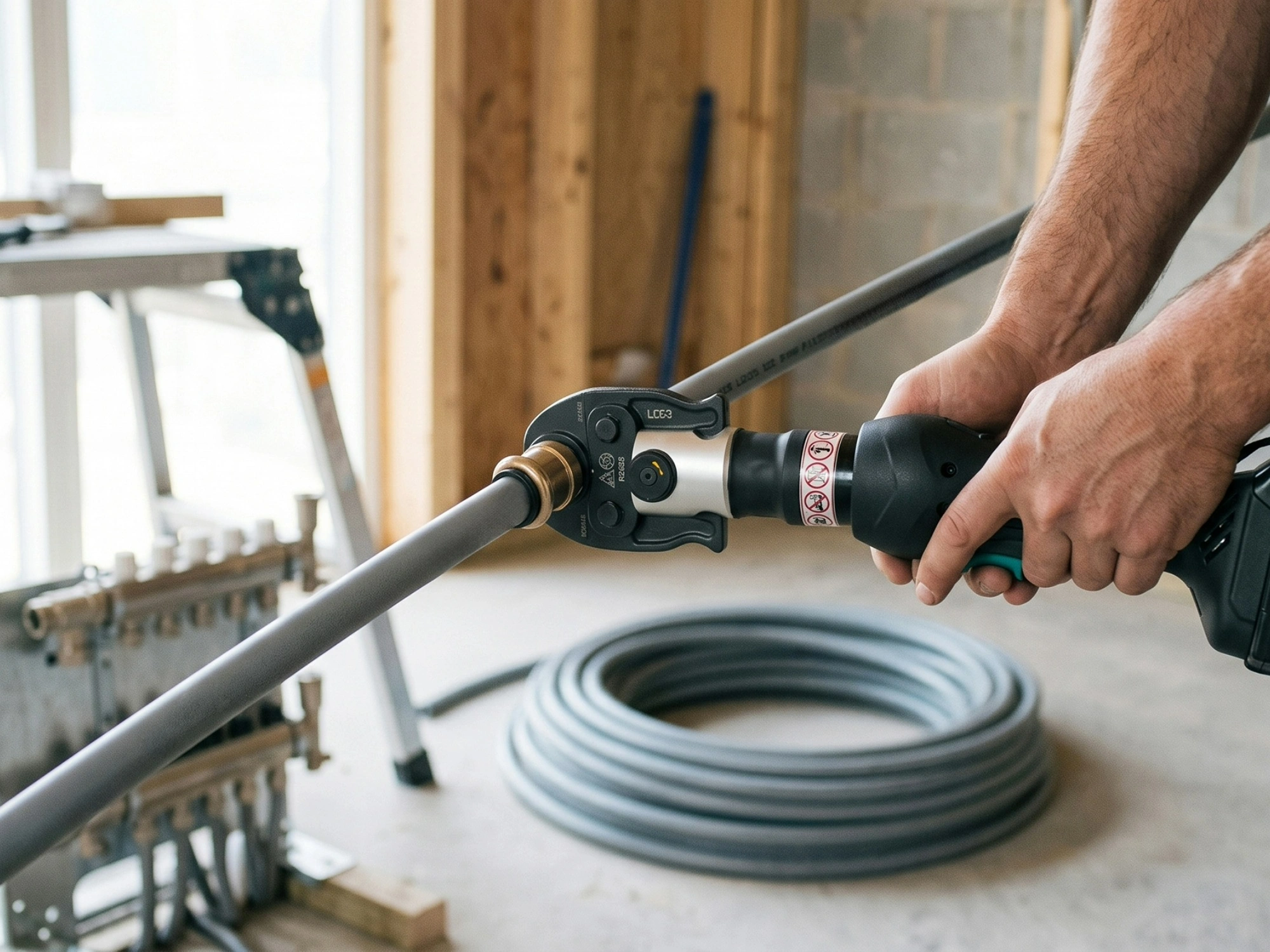
Multi-Layer Composite Pipe (MLCP) is built from an aluminium core sandwiched between two layers of Polyethylene Raised Temperature (PE-RT), bonded together with adhesive layers. The aluminium core gives the pipe its shape retention and oxygen barrier, while the PE-RT layers protect against corrosion and abrasion. Once cut, the pipe is joined using a press tool that mechanically crimps a stainless steel or brass fitting permanently around it.
Advantages of MLCP over push fit
Both systems do away with open flame and solder, but the way each one forms a joint is fundamentally different, and that difference matters once a project is finished and the pipework is out of sight.
A joint that can’t be pulled apart
Push fit relies on an O-ring and a grab ring to hold the pipe in place. Get the insertion depth wrong, catch the O-ring on a burr, or knock the joint out of position later on, and there’s a risk the connection can fail. MLCP press fittings work differently. The press tool permanently deforms the fitting around the pipe, creating a mechanical joint that can’t be undone once it’s made, with no reliance on a grab ring holding firm under movement or pressure changes.
Built to be buried
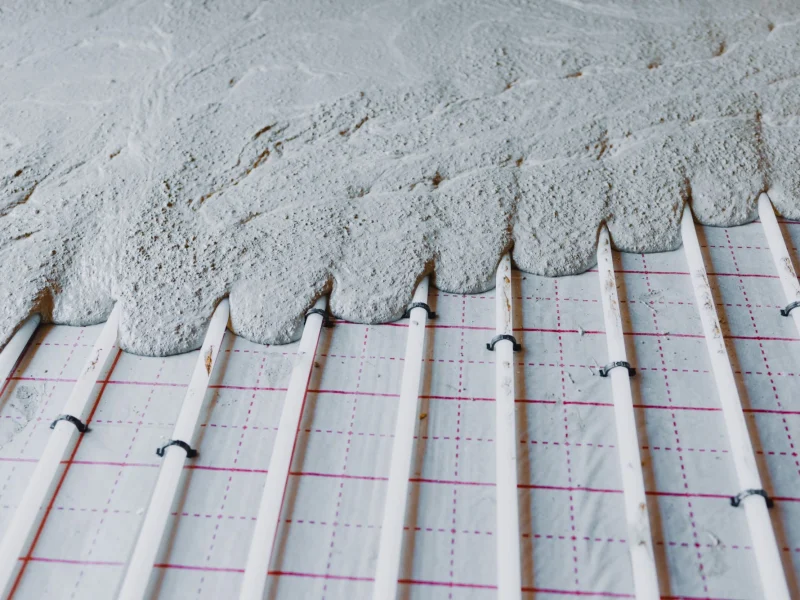
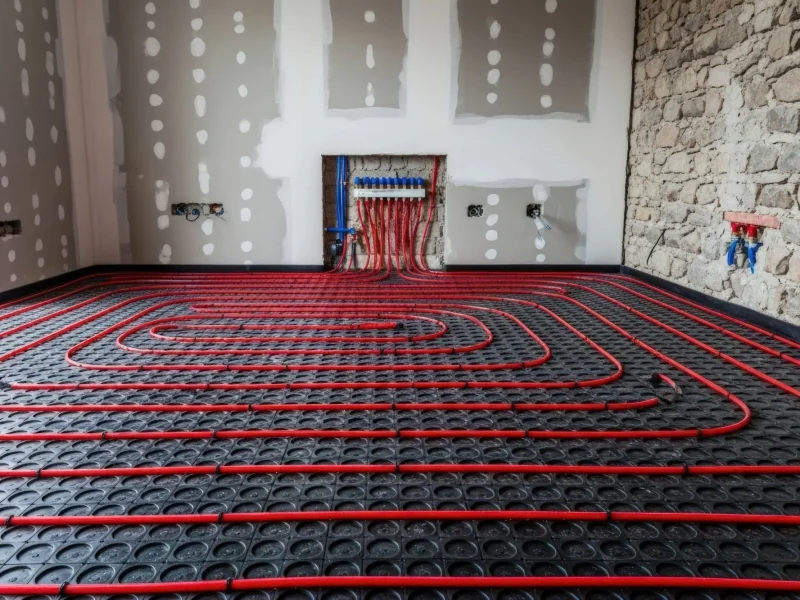
Underfloor heating pipework doesn’t stay accessible once it’s down. It gets screeded over, and if a joint fails under the floor, that’s a big job to put right. MLCP press systems are widely recommended by manufacturers for encapsulated and inaccessible installations, which is a large part of why MLCP has become the industry standard for UFH manifolds and distribution pipework. Push fit systems are generally intended to remain accessible, since the joint depends on a mechanical grab ring rather than a permanent crimp. Always check the specific manufacturer’s guidance before burying any joint.
Fewer weak points
A press tool applies a calibrated, repeatable crimp every time. Push fit depends on the installer pushing the pipe fully home to a witness mark, which is easy to get wrong in a tight cupboard, overhead, or at the end of a long shift. Fewer variables on site means fewer callbacks.
Corrosion resistance that lasts
The aluminium core and PE-RT layers give MLCP a complete oxygen barrier along with resistance to scale build-up and galvanic corrosion, particularly valuable in hard water areas or where pipework ties into mixed-metal systems.
Long-term stability
MLCP’s aluminium core keeps thermal expansion low, so pipe runs stay put rather than moving as the system heats and cools. High-quality MLCP systems also carry long manufacturer warranties when installed to spec, giving confidence in both new build and retrofit work.
Costs less than you’d think
Cost is often the thing that makes installers hesitate before switching, but it shouldn’t. We’ve priced our MLCP range directly against equivalent push fit sizes, and in most cases MLCP works out cheaper, not more expensive. Installers making the switch are seeing real savings on the sizes they use most, on top of everything else MLCP gets right for a permanent joint.
Where push fit still has a place
Push fit isn’t obsolete. For quick, accessible repairs and above-ground pipework where speed matters more than permanence, it still does a job well. But for anything going under a floor, behind a wall, or into a project you don’t want to revisit, MLCP is the stronger choice.
Making the switch to MLCP
If push fit has been the default on your van, switching to MLCP means a different press tool and jaw profile, but the workflow on site stays much the same. At Warm-Flo, we stock a full range of MLCP pipe, fittings and press tools, including pre-cut 3m straightened lengths so you’re not left buying a full coil for a job that only needs a few short runs. Our team can talk you through the right jaws, tooling, and pipe format for the switch. We’re putting a big focus on MLCP over the coming months in terms of stock levels, technical support, and more, so if you’re thinking about making the move, now’s a good time to talk to us.
Frequently asked questions
Can push fit fittings be buried under a floor or in a wall?
It depends on the manufacturer, and guidance varies by product range, so always check before burying any joint. Many push fit ranges are designed to remain accessible. MLCP press fittings are widely approved for encapsulated installations, which is why they’re the go-to for underfloor heating.
Do I need new tools to switch to MLCP?
Yes. You’ll need an MLCP-compatible press tool and jaw profile, plus a pipe cutter and bevelling tool for prep. Speak to the team for advice on the right setup for your work.
Is MLCP more expensive than push fit?
No, if anything, it’s usually the other way round. We’ve priced our MLCP range directly against equivalent push fit sizes, and installers making the switch are seeing real savings rather than paying a premium. Talk to the team for a direct comparison on the sizes you use most.
The case for making MLCP your default
More installers are making MLCP their default, not just for underfloor heating, but across general pipework where a permanent joint counts. If you’re ready to make the switch, our team can help you find the right pipe, fittings and tooling to get started.
Browse our MLCP and press fittings range or talk to the team today.