Controls are one of those elements of an underfloor heating installation that can feel like an afterthought. The pipe goes in, the screed goes down, the manifold is commissioned, and then someone asks what thermostats are going on the walls.
It should not work that way. The control strategy affects how a UFH system is zoned, how the manifold is specified, what wiring is required, and ultimately how well the finished system performs for the end user. Getting it right at specification stage saves time on site and avoids the callbacks that come from a system that is difficult to operate or fails to deliver consistent comfort across the building.
This guide covers the key decisions: how many zones you need, what types of thermostats are available, and how to match the control strategy to the installation.
Why controls are a specification decision, not a finishing touch
The number of zones in a UFH system determines the manifold size, the number of actuators, the wiring centre configuration, and in some cases the pipe circuit layout. These are not decisions you can easily unpick once the system is in the ground.
On a manifold-fed system, each zone typically corresponds to a circuit (or group of circuits) controlled by an actuator on the manifold, which opens and closes in response to a signal from the thermostat in that room or area. Specify fewer zones than the building needs, and you lose the ability to control different areas independently. Specify more than necessary and you add cost and complexity without a corresponding benefit.
Getting the control strategy right before specifying the manifold is not just good practice; it is essential.
How many zones does an underfloor heating system need?
There is no single answer to this. The right number of zones depends on the building type, the way it will be used, and the expectations of the end user.
Single-zone systems
On smaller installations like a single open-plan space, an extension, or a straightforward domestic retrofit, a single zone is often appropriate. One thermostat controls the system as a whole, which keeps commissioning simple and running costs manageable.
The limitation is flexibility. If the building has rooms with significantly different heat demands, for example, a south-facing living room versus a north-facing bedroom, a single zone cannot compensate for that difference.
Multi-zone systems
Most new build and larger domestic installations benefit from multi-zone control, with a separate circuit and thermostat for each room or defined area. Each zone is controlled independently, which means the living room can be set at a different temperature to the hallway, and rooms that are unoccupied can be turned down without affecting the rest of the building.
On a manifold-fed system, this is straightforward to achieve. Each zone has its own port on the manifold with an actuator, controlled from a thermostat in the relevant room. The wiring feeds back to a central wiring centre, which coordinates the call-for-heat signal to the boiler or heat pump.
A general starting point is one zone per room for any space with meaningfully different usage patterns or heat demand. Bedrooms, bathrooms, living areas and open-plan kitchen-diners each typically warrant their own zone. Hallways and utility areas are often grouped with an adjacent zone.
Types of UFH thermostat: from manual to smart
The thermostat market has changed considerably in recent years. The options now range from simple manual controls through to fully programmable WiFi systems with remote access and smart home integration.
Manual and dial thermostats
The simplest option. The user sets the desired temperature using a dial or basic controls, and the system responds accordingly. There is no programming and no remote access. Instead, the thermostat does one job and does it reliably.
Manual thermostats suit commercial applications, rental properties, or installations where simplicity is the priority and the end user does not want or need a programmable system.
Programmable thermostats
Programmable thermostats allow the user to set different temperatures for different times of day or days of the week. This makes them well suited to residential installations where occupancy patterns are predictable. Heating can be scheduled to come on before the household wakes up and drop back during the day when the building is empty.
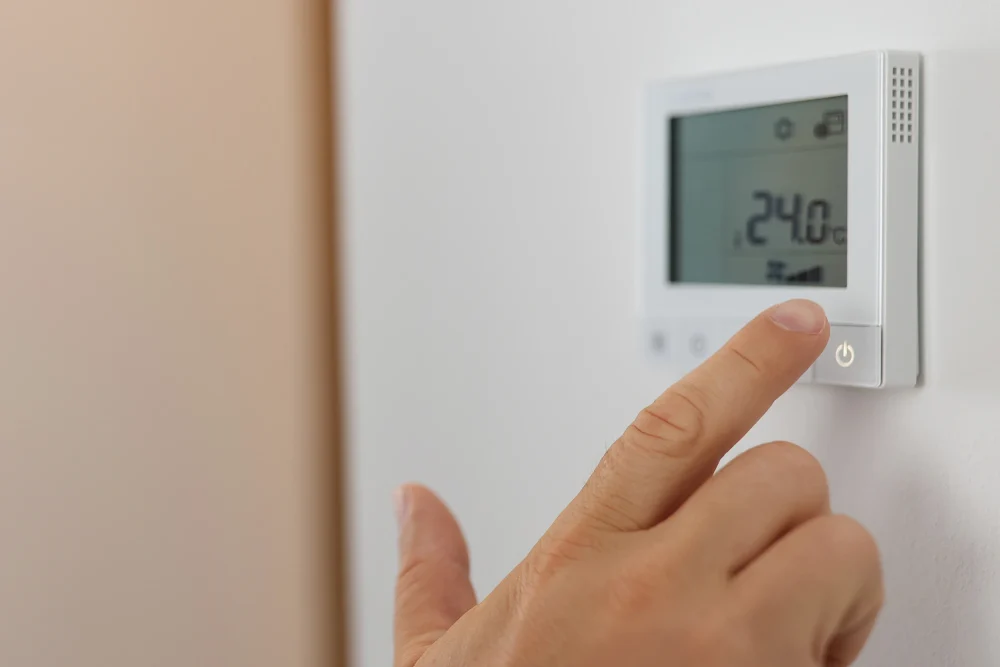
For underfloor heating specifically, the slow thermal response of a screed floor means scheduling matters more than it does with radiators. A programmable thermostat that brings the system on in advance of occupancy works significantly better than one reacting to the room being cold.
WiFi and smart thermostats
WiFi thermostats allow the end user to control the system remotely via a smartphone app. For heating installers, the practical advantages are straightforward: scheduling is easier to set up, the user can adjust settings from anywhere, and many systems provide usage data that helps optimise running costs over time.
On new build handovers, smart thermostats are increasingly expected as standard. They are a visible, tangible feature that clients notice and value – and for developers handing over properties, they are part of what makes the system feel complete and well specified.
Wired vs wireless: what suits the installation?
Wired thermostats connect directly to the wiring centre via low-voltage cable, running back to the manifold location. They are reliable, have no battery to replace, and are well suited to new build installations where cable runs can be planned and chased into walls before plastering.
Wireless thermostats communicate with a receiver at the wiring centre via radio frequency. They are significantly faster to install (particularly on retrofit projects where running cable through existing construction is impractical) and avoid the need for decorating around thermostat cable drops.
The trade-off is that wireless systems rely on batteries and on signal strength. In properties with thick walls or substantial distances between thermostat and receiver, signal can be an issue. Most wireless systems include signal strength indicators that flag problems at commissioning, which makes this easier to manage.
For most new build projects, wired is the cleaner solution. For retrofit, wireless is often the practical one.
Smart thermostats and manifold-fed systems
One of the advantages of a manifold-fed system, whether for underfloor heating, radiators, or a combination of both, is how cleanly individual zone control integrates.
Each circuit runs back to the manifold independently. Adding an actuator to each port and wiring it to a corresponding thermostat gives granular zone control without the complexity of branching pipework. WiFi thermostats in each room then allow the end user to manage those zones individually from a single app.
This is a well-proven configuration on new build residential projects and increasingly common on larger domestic extensions. The combination of a Warm-Flo manifold, zone actuators and WiFi thermostats gives the installer a clean system to commission and the end user a system that is intuitive to operate.
What to specify and when
The control strategy should be agreed and documented before the manifold is ordered. At a minimum, the specification should confirm the number of zones and which rooms each zone covers. It should also state whether wired or wireless thermostats are being used, the thermostat type, the wiring centre location, and cable routing for wired systems.
Warm-Flo’s design service includes controls coordination as part of the full system design – zone layouts are planned alongside pipe circuits and manifold configuration, so the whole system is specified coherently before installation begins.
Get the controls right from the start
A well-specified control strategy makes an underfloor heating system easier to install, easier to commission, and easier for the end user to live with. Decisions like how many zones, which thermostat type, wired or wireless, become straightforward once you know what the installation needs.
If you have a project in the pipeline and want to talk through the controls setup, contact the Warm-Flo team for free advice. We stock a range of thermostats and controls alongside our full UFH product range, and our design service can incorporate zone layouts and controls coordination from the outset.